



A governance proposal submitted to BonkDAO on June 30 instructed the DAO to transfer 4.426 trillion BONK to a wallet listed in the proposal itself. Six days later, after an anonymous wallet accumulated just enough BONK to meet the DAO’s voting threshold, the proposal passed and the transfer executed automatically.
- A trader executes a $21.2 million treasury drain from BonkDAO by passing a malicious governance proposal on the Solana network.
- The attacker spent $4.4 million on Binance and Bybit to accumulate 882 billion BONK, exceeding the one percent quorum requirement.
- This incident proves that BonkDAO governance serves as a primary attack surface for hostile takeovers without requiring software or protocol exploits.
Blockchain records show the proposer spent about $4.4 million acquiring voting power before receiving tokens worth roughly $21.2 million from the treasury.
Proposal Named the Destination Wallet
The proposal, BIP #76, titled “Sowellian BonkDAO,” was submitted through BonkDAO’s governance portal on Solana’s Realms platform.
Its published objectives included implementing “Sowellian governance,” appointing new council members, rebuilding the DAO, monetizing treasury holdings and stopping the bleeding. It also stated that “all YES voters are eligible to receive tokens.”
Among the proposal’s execution instructions was an order directing the DAO to transfer 4.426 trillion BONK from the treasury to wallet 9bxWkNf3BtJ6iehq9KbX9uCWMjem4TFiPZ19T2sYJHvQ if the measure passed.
Have a development worth tracking?
Share product launches, funding announcements, partnerships, research findings and market developments with The Grey Terminal's readership.
→ Submit a Press Release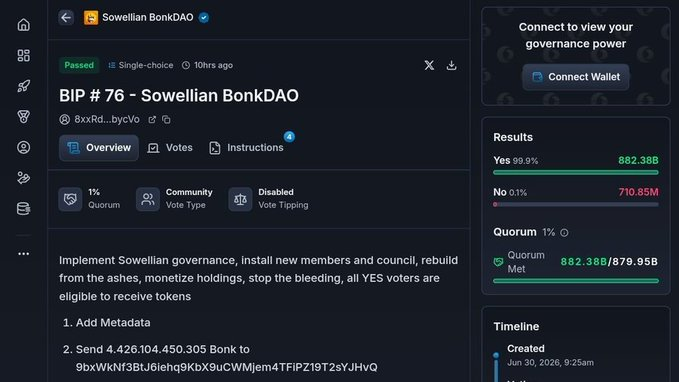
Voting Power Was Acquired Before the Vote
According to Lookonchain, a related wallet accumulated approximately 882.38 billion BONK through purchases on Binance and Bybit during the days leading up to the vote.
That position exceeded BonkDAO’s governance quorum of 879.95 billion BONK, equivalent to 1% of the token’s voting supply, by roughly 2.4 billion BONK.
When voting closed, the proposal received 882.38 billion BONK in support and 710.85 million BONK against. Only seven wallets participated in the vote.
The governance contract then executed the approved instructions, transferring 4.426 trillion BONK from the treasury to the destination wallet specified in the proposal.
Treasury Assets Remain Traceable On-Chain
BonkDAO later described BIP #76 as a malicious governance proposal that resulted in an estimated $20 million being drained from the treasury.
The organization said it identified the exchange wallets used to acquire BONK before the vote and has notified law enforcement. BonkDAO said it is working with exchanges, bridge operators and the Solana Foundation to recover the transferred assets and identify those responsible.
According to Lookonchain, approximately 40 billion BONK, worth about $188,000, has since been deposited to OKX. The remaining 4.386 trillion BONK, valued at roughly $19.3 million, remains visible on-chain after being transferred to another wallet.
Governance Votes Have Been Used to Target DAOs Before
The incident adds to a small group of governance attacks that have targeted decentralized autonomous organizations by acquiring enough voting power to authorize treasury transfers.
In 2022, an attacker used flash loans to obtain temporary voting power in the Beanstalk protocol before approving a proposal that drained about $182 million from its treasury. The BonkDAO incident followed a different path. Blockchain records indicate the voting power was accumulated through token purchases on the open market rather than borrowed liquidity.
Grey Terminal Note
Every financial system has a mechanism that determines who is authorized to move assets. In BonkDAO, that authority was assigned through token ownership and exercised by an on-chain vote. The proposal, the votes and the resulting treasury transfer are all publicly verifiable. The records establish how control of the treasury changed hands. Whether the governance rules produced the outcome the community intended is a question the blockchain records, but cannot answer.
Activate Terminal Layer
Structural analysis of the systems, pressures, and stakeholders behind this story.