

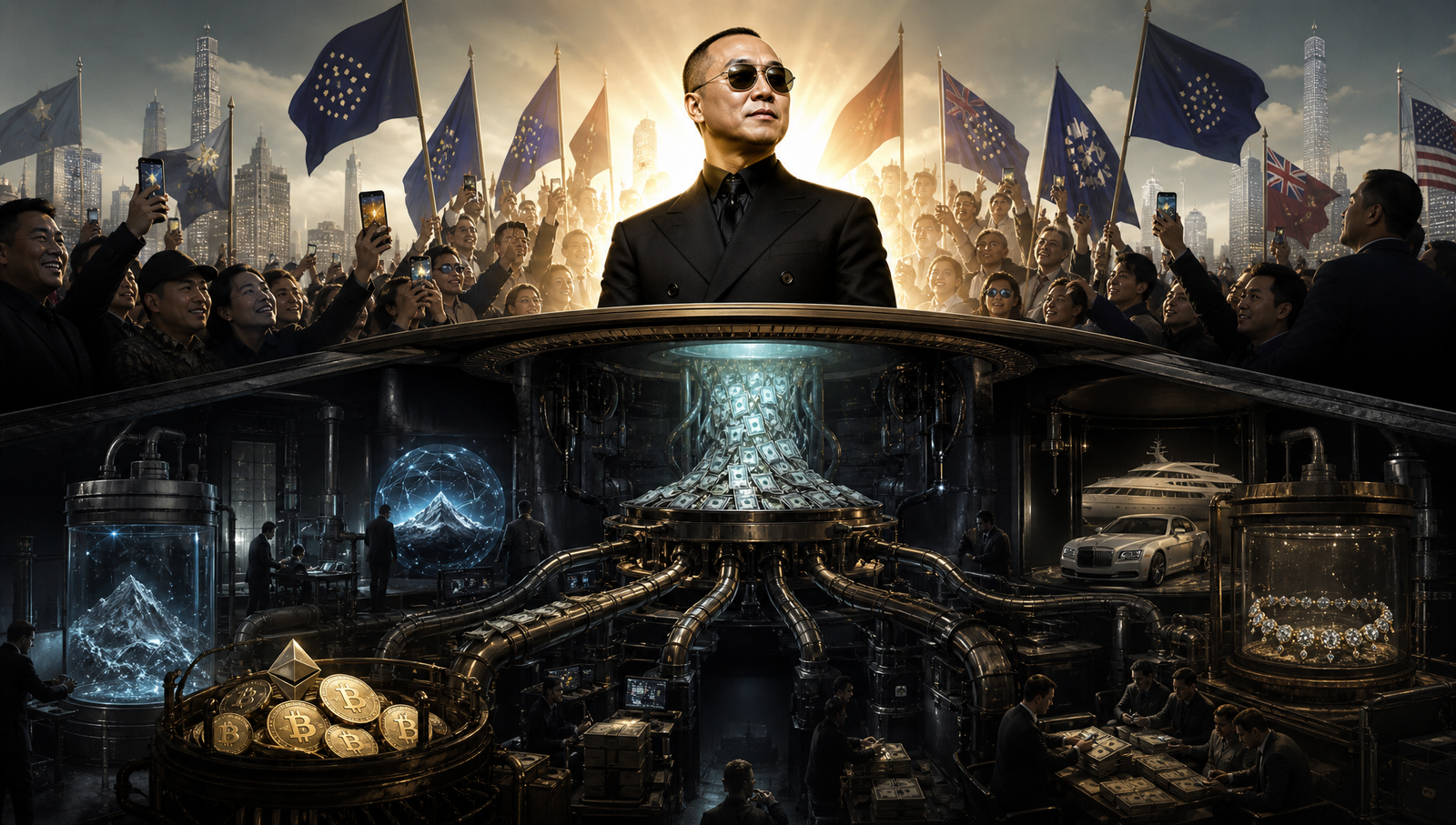

Guo Wengui, the self-exiled Chinese businessman who built a large online following by presenting himself as an opponent of the Chinese Communist Party, was sentenced to 30 years in prison after a U.S. court found him guilty in a fraud case prosecutors said involved more than $1 billion.
- Guo Wengui receives a thirty-year prison sentence for orchestrating a one-billion-dollar fraud involving Himalaya Exchange and GTV Media Group.
- Judge Analisa Torres orders Guo to forfeit $889 million after finding him guilty of deceiving thousands of anti-CCP supporters.
- The case exposes how political influencers weaponize online communities to distribute unregistered digital assets and circumvent traditional financial oversight.
The sentence followed a seven-week trial in which prosecutors accused Guo of using his political messaging, online influence and investment platforms to raise money from thousands of supporters.
The case brought together three areas that have increasingly overlapped in the digital economy: political movements built online, influencer-driven fundraising and cryptocurrency markets.
Prosecutors said Guo used ventures including media companies, investment programs and a cryptocurrency platform to convince followers to provide funds for businesses and causes connected to his anti-CCP movement.
Guo has maintained that he was targeted because of his political opposition to the Chinese government.
Have a development worth tracking?
Share product launches, funding announcements, partnerships, research findings and market developments with The Grey Terminal's readership.
→ Submit a Press ReleaseWho Is Guo Wengui?
Guo, also known as Miles Guo, Ho Wan Kwok and Miles Kwok, became a prominent figure among Chinese dissidents overseas after leaving China during an anti-corruption campaign.
He gained a large online audience by claiming to expose corruption within the Chinese Communist Party and sharing allegations about Chinese officials.
His influence expanded through online media projects, including GTV Media Group, and political initiatives such as the New Federal State of China movement.
The government argued that Guo’s public image as a political activist helped build trust among followers who later invested in projects he promoted.
Prosecutors said many victims believed they were supporting efforts connected to democracy activism while also participating in legitimate investment opportunities.
The Crypto Connection: Himalaya Exchange and Digital Tokens
One of the most significant parts of the case involved Himalaya Exchange, a cryptocurrency platform linked to Guo.
Prosecutors said the platform promoted digital assets including Himalaya Coin, also known as H-Coin or HCN, and Himalaya Dollar.
The government alleged investors were encouraged to buy the tokens through claims that they were backed by assets, including statements that H-Coin had gold backing.
According to prosecutors, the cryptocurrency operation raised about $262 million.
The case became one of several examples cited by regulators of how digital assets can be used to reach large numbers of retail investors quickly, particularly when combined with online communities and influential personalities.
The issue, prosecutors argued, was not the existence of blockchain technology itself but how the investment products were marketed and represented to buyers.
A Network of Media, Memberships and Investment Programs
The fraud allegations extended beyond crypto.
Prosecutors said Guo and his associates operated multiple fundraising schemes that brought in more than $1 billion from investors between roughly 2018 and 2023.
The largest alleged schemes included:
- GTV Media Group: Prosecutors said Guo used unregistered stock offerings that raised approximately $452 million.
- Himalaya Farm Alliance: Authorities alleged the program raised about $150 million through fraudulent investment claims.
- G|CLUBS and membership programs: Prosecutors said these initiatives raised hundreds of millions of dollars.
Guo’s former chief of staff, Yvette Wang, was also convicted in connection with the schemes and sentenced to 10 years in prison.
Prosecutors Say Investor Funds Paid for Luxury Lifestyle
During the trial, prosecutors argued that money raised through the schemes was used to finance Guo’s personal spending.
Authorities pointed to luxury properties, vehicles, a yacht and other high-value purchases as evidence that investor funds were diverted for personal use.
Among the assets cited were a large New Jersey mansion, a Manhattan apartment overlooking Central Park, luxury vehicles including a Lamborghini, and a yacht valued at tens of millions of dollars.
Prosecutors described the operation as a fraud that relied heavily on the loyalty of Guo’s supporters and the trust he built through his political messaging.
Judge Says Scheme Had “Stunning Breadth”
At sentencing, Judge Analisa Torres said Guo showed “no remorse” and described the schemes as having “stunning breadth.”
The judge said Guo “intended to deceive his victims and take their money for his own financial gain.”
The court ordered Guo to forfeit $889 million.
Guo continued to deny wrongdoing and his supporters have argued that the case was politically motivated.
Impact on Crypto and Online Finance
The case highlights a broader challenge facing digital finance: the growing connection between online influence, financial products and investor trust.
Crypto markets have created new ways for projects to raise capital and build communities outside traditional financial institutions.
But the same characteristics that make digital assets accessible — global reach, fast distribution and online communities, can also make it easier for misleading claims to spread.
The Guo case underscores the importance of evaluating financial opportunities based on disclosures, structure and evidence rather than reputation or online influence alone.
The investigation was not about blockchain technology itself. It was about how financial products were promoted and the trust relationship between a seller and investors.
The Grey Terminal Note
The Guo Wengui case represents a broader shift taking place across modern finance.
Capital is no longer moved only through banks, brokerages or traditional institutions. It increasingly moves through online communities, personalities and digital platforms.
That creates new opportunities for entrepreneurs and investors, but it also changes where risk appears.
In traditional finance, trust is often built through regulation, disclosures and intermediaries. In the digital economy, trust can be built through attention.
The challenge for markets is determining when that attention represents genuine innovation and when it becomes the foundation of a financial scheme.
Activate Terminal Layer
Structural analysis of the systems, pressures, and stakeholders behind this story.