

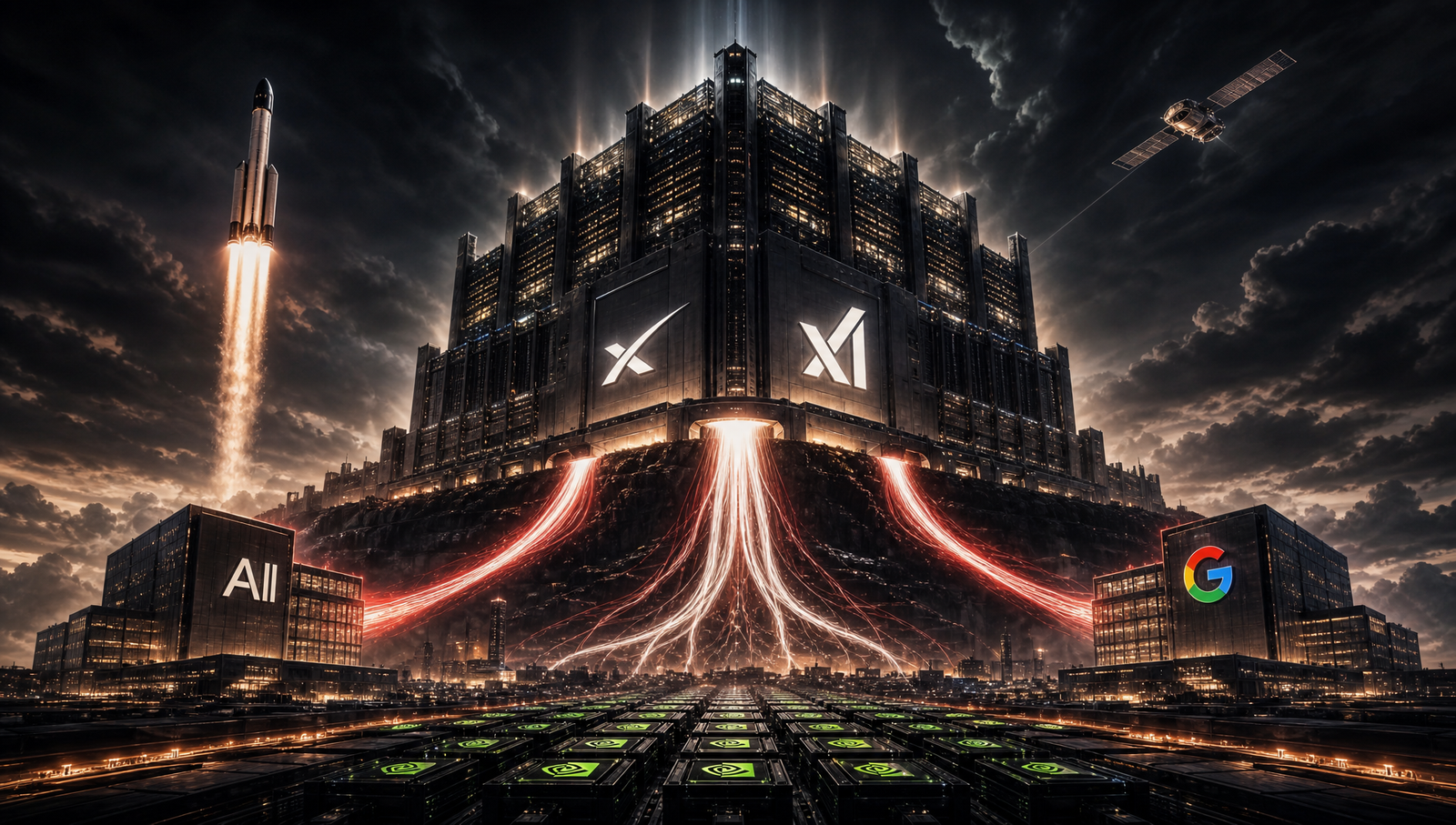

Anthropic and Google are spending more than $2 billion a month on compute tied to Elon Musk’s companies. They are not buying rockets or satellites. They are renting Nvidia chips at a Memphis data center that SpaceX now controls.
- Anthropic and Google pay Elon Musk’s SpaceX over $2 billion monthly to rent Nvidia chips at the Memphis Colossus facility.
- Anthropic allocates $1.25 billion per month for compute while Google contributes $920 million monthly to access the massive GPU cluster.
- SpaceX controls the physical infrastructure necessary for Anthropic and Google to develop AI models that directly compete with Musk’s Grok.
In Memphis, Tennessee, a massive GPU cluster originally built by xAI has become a critical piece of the AI supply chain. Known as Colossus, the facility was designed to power Grok, Musk’s AI model, but its computing capacity is now also being used by other major players racing in the same field.
After SpaceX absorbed xAI in February 2026, the infrastructure behind Colossus became part of a broader technology ecosystem spanning artificial intelligence, aerospace and satellite networks. Anthropic and Google have secured significant access to Colossus capacity. Anthropic is reportedly paying about $1.25 billion per month, while Google is paying roughly $920 million per month.
The companies are not buying rockets or satellite systems. They are buying access to one of the scarcest resources in AI: Nvidia-powered computing capacity.
Compute Becomes the Strategic Layer
For years, artificial intelligence competition centered around research talent, algorithms and data. That equation is changing.
Have a development worth tracking?
Share product launches, funding announcements, partnerships, research findings and market developments with The Grey Terminal's readership.
→ Submit a Press ReleaseFrontier models require enormous amounts of processing power, and demand for advanced GPU clusters has grown faster than supply. Building these systems requires capital, energy, hardware and time, creating a new advantage for companies capable of assembling infrastructure at scale.
Compute is no longer just an operating cost. It is becoming a strategic resource. The companies that secure access to the largest clusters gain the ability to train larger models, iterate faster and compete at a different level.
The Infrastructure Advantage
SpaceX’s position in AI is unusual because its role comes through ownership of xAI’s infrastructure rather than through operating as a traditional cloud provider. By absorbing xAI, SpaceX gained control of Colossus while remaining connected to its own AI ambitions through Grok.
The company is also pursuing longer-term AI infrastructure concepts beyond Earth, including its proposed Starmind satellite network. That project remains a future-facing ambition, but it reflects the wider shift happening across technology: AI infrastructure is moving beyond software platforms and into physical systems.
The structure creates a pattern familiar from cloud computing: competing companies often rely on the same underlying infrastructure providers. The difference is that the provider here is also building competing AI products.
The Race Beneath the Race
The public AI battle is usually measured through model releases, benchmark scores and consumer products. The infrastructure battle is quieter.
It happens through chip supply agreements, data center construction and access to the machines that make AI development possible. As more companies compete for compute, the companies controlling that layer gain influence over the wider ecosystem.
They do not need to win every model race. They benefit from the market growing around the infrastructure they provide.
The Grey Terminal Note
The artificial intelligence race is usually described as a competition between models. The deeper contest is forming underneath: who owns the physical systems those models depend on.
AI companies may compete over intelligence, but intelligence still requires machines, energy and infrastructure. As compute becomes harder to secure, the companies controlling that foundation gain a different kind of power.
The future of AI may not belong only to whoever builds the smartest model. It may also belong to whoever owns the machines running it.
Activate Terminal Layer
Structural analysis of the systems, pressures, and stakeholders behind this story.