

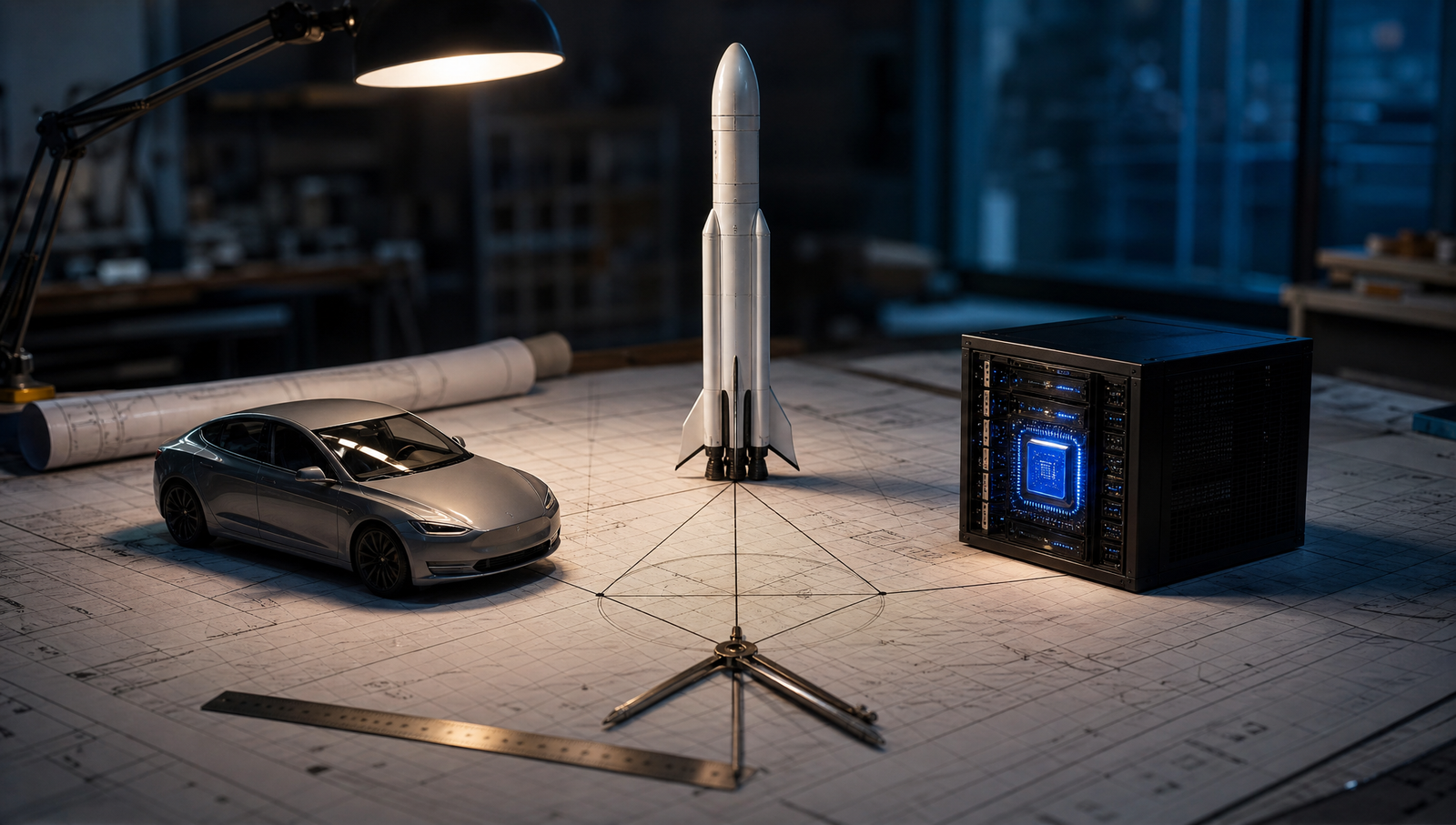

Elon Musk has applied a consistent set of principles across nearly three decades building companies from Zip2 in the 1990s to Tesla, SpaceX and xAI. These approaches have enabled entry into mature industries, challenged entrenched assumptions, and produced both transformative advances and notable setbacks.
- Elon Musk scales Tesla, SpaceX, and xAI by applying 10 specific principles rooted in utility and first principles reasoning.
- SpaceX survived 2008 after the fourth Falcon 1 launch reached orbit, securing a multibillion-dollar NASA contract following three previous failures.
- The xAI team compressed a 24-month infrastructure build into six months, illustrating Musk’s strategy of treating time as an engineering variable.
The framework offers founders and operators a practical lens for problem-solving, risk assessment and capital allocation. It is not a guaranteed formula for success.
1. Build Something Useful Before Trying to Build Something Great
Musk starts with solvable problems. “I didn’t originally think I would build something great,” he said. “I wanted to try to build something useful.” Zip2, founded in 1995, supplied newspapers with online directories, maps and navigation tools.
Tesla first proved electric vehicles could match or exceed gasoline performance. SpaceX targeted lower-cost orbital access. xAI began with computing infrastructure for training models. Utility created the base. Larger ambitions followed.
2. Start From First Principles, Not Industry Convention
Musk reduces problems to fundamental truths. “First principles just means you break things down to the fundamental axiomatic elements that are most likely to be true, and then reason up from there,” he has said.
Have a development worth tracking?
Share product launches, funding announcements, partnerships, research findings and market developments with The Grey Terminal's readership.
→ Submit a Press ReleaseSpaceX examined rockets by raw materials; aluminum, titanium, carbon fiber, which formed only a small fraction of historical prices. The company brought more production in-house and developed reusability, lowering costs and reshaping commercial spaceflight. The same method guided Tesla battery production and xAI’s AI cluster build.
3. Create Opportunity When None Is Offered
Musk builds when entry is blocked. After failing to secure a job at Netscape in 1995, he co-founded Zip2. He entered automotive manufacturing at Tesla without industry experience.
He launched SpaceX in a government-dominated field. He created xAI to pursue a different AI direction.
The pattern treats barriers as engineering problems. It requires operating without incumbents’ safety nets.
4. Reinvest in the Next Mission
Musk has repeatedly deployed exit proceeds into higher-risk ventures. The 1999 sale of Zip2 to Compaq yielded roughly $22 million, much of which funded X.com (later part of PayPal).
After eBay’s 2002 acquisition of PayPal, capital flowed into SpaceX and Tesla. By 2008 both companies faced near-collapse.
SpaceX survived after its fourth Falcon 1 reached orbit in September 2008 and secured a multibillion-dollar NASA contract. The strategy concentrates resources but risks simultaneous failure.
5. Treat Failure as Data
SpaceX’s early Falcon 1 launches show the process. The first three missions (2006–2008) failed on technical issues.
Musk told early employees the company faced roughly a 90% chance of failure. Engineers reviewed data, redesigned and relaunched. The fourth succeeded on Sept. 28, 2008, becoming the first privately developed liquid-fueled rocket to reach orbit. NASA soon awarded a major resupply contract.
Failure supplied engineering information. Similar iteration appears in Tesla production scaling.
6. Treat Time as an Engineering Variable
Musk decomposes schedules into constraints. Suppliers projected 18–24 months for xAI’s large AI training cluster. Engineers tackled power, cooling, networking and construction in parallel with temporary systems.
The cluster became operational in roughly six months.The approach shortened cycles at SpaceX and Tesla. It also produced public misses, including multiple Full Self-Driving targets and Cybertruck timelines. Compression reveals inefficiencies. It does not override physics or supply chains.
7. Protect the Feedback Loop to Reality
Musk warns against losing touch with evidence. “A major failure mode is when ego-to-ability ratio gets too high,” he said. “Then you’re going to break the feedback loop to reality.”
Rockets reach orbit or fail. Production lines meet targets or miss. Organizations lose clarity when leaders defend assumptions against data. Musk pushes rapid testing and iteration. His own record shows the difficulty, some public forecasts have outpaced results.
8. Build Around a Mission, Not an Exit
Musk often begins with long-term problems. SpaceX addressed the lack of a credible Mars plan. Tesla targeted sustainable energy acceleration. xAI focuses on understanding the universe. Missions extend beyond quarterly results and attract talent and capital for extended timelines. Commercial success follows as a byproduct.
9. Prioritize Usefulness Over Recognition
Musk measures contribution by value created. “It’s so hard to be useful,” he has said. “Don’t aspire to glory. Aspire to work.”
Zip2 aided early digital navigation. PayPal simplified payments. Tesla expanded EV investment. SpaceX lowered launch costs. xAI competes in a key technology area. Each solved a distinct need. Recognition is a consequence.
10. Build Institutions That Can Outlast the Founder
Musk’s companies target enduring capabilities. SpaceX conducts crewed missions and large satellite deployments. Tesla influenced global EV investment. xAI operates in a multi-decade race. Institutional strength ultimately matters more than association with one leader.
Where the Framework Meets Reality
The principles have driven disruption across industries. They have also produced delays, intense cultures and missed forecasts.
Tesla repeatedly missed Full Self-Driving targets and Cybertruck timelines. Demanding schedules at Tesla, SpaceX and X have drawn criticism for burnout and turnover.
High-risk reinvestment nearly collapsed both SpaceX and Tesla in 2008. Many startups embracing similar intensity lack the capital or conditions for recovery. The principles describe a repeatable way of thinking. Execution, timing, capital and external factors decide outcomes.
The framework’s discipline; identify solvable problems, question assumptions, decompose complexity, learn from data and reinvest in larger objectives, has been tested for three decades.
Founders can apply elements of that rigor even if outcomes differ.
Activate Terminal Layer
Structural analysis of the systems, pressures, and stakeholders behind this story.