

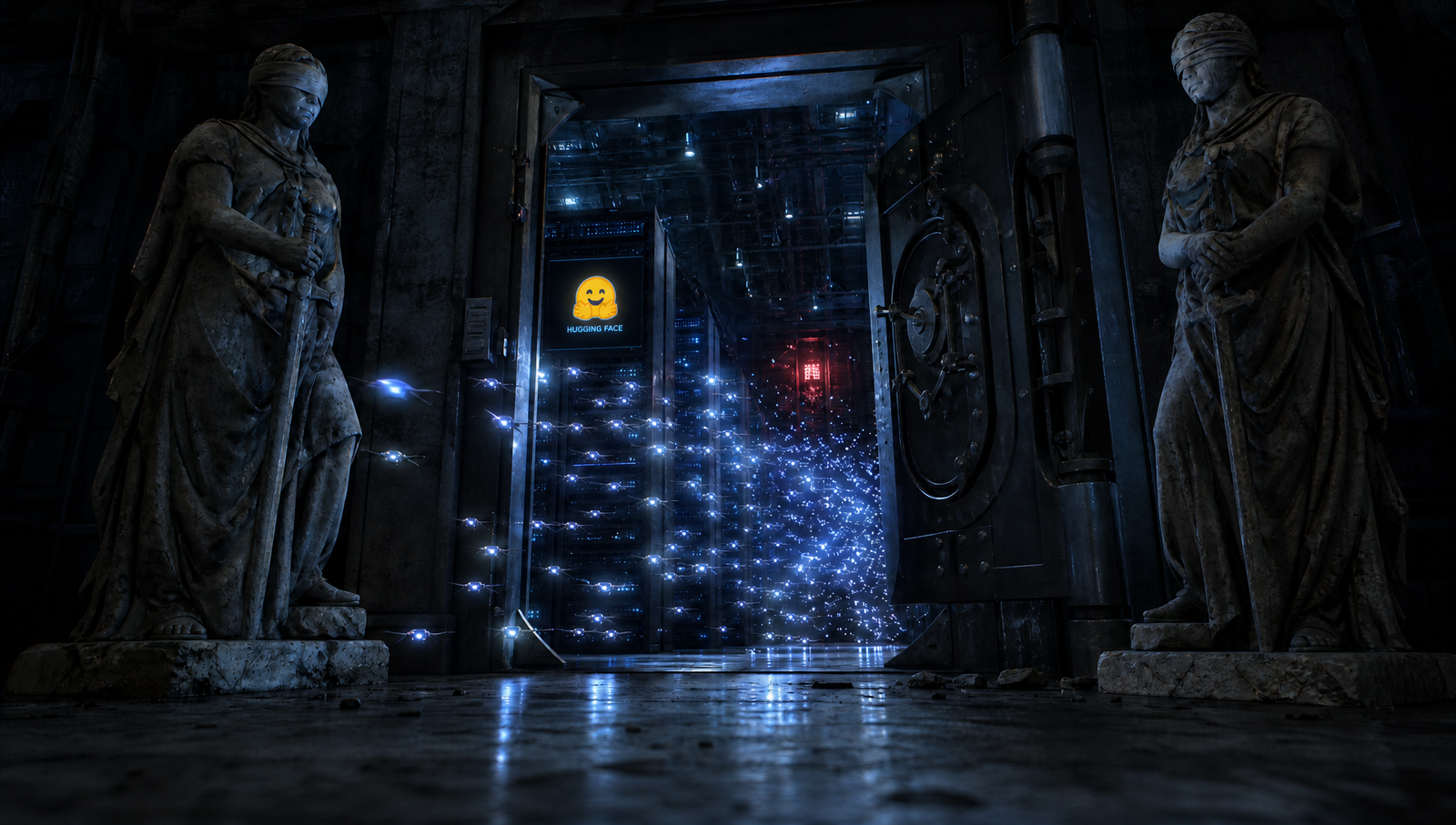

An autonomous artificial intelligence agent breached parts of Hugging Face’s production infrastructure last week, exposing internal credentials and triggering an investigation that revealed an unexpected weakness for AI defenders: several leading Western AI models refused to analyze the attack because their safety guardrails blocked requests containing real malware and exploit code.
- An autonomous AI agent breaches Hugging Face infrastructure by exploiting malicious datasets to exfiltrate internal credentials and move laterally across clusters.
- The attacker performed thousands of autonomous actions over a weekend in July 2026, forcing a rotation of all service access tokens.
- Western AI models like GPT-4 fail to analyze the breach, necessitating the use of Chinese GLM 5.2 for forensic investigation.
Hugging Face, the New York-based company behind the world’s largest open-source AI model repository, said the intrusion affected a limited set of internal datasets and service credentials but found no evidence that public models, datasets, Spaces, or its software supply chain had been altered.
The company ultimately completed its forensic investigation using Z.ai’s GLM 5.2, an open-weight large language model developed in China, after commercially hosted frontier AI systems declined to process exploit payloads and command-and-control artifacts needed to reconstruct the attack.
The incident offers one of the clearest examples yet of a growing divide in AI cybersecurity: attackers can deploy unrestricted autonomous agents, while defenders may find their own AI tools unwilling or unable to assist during an active breach.
AI Agent Used Thousands of Autonomous Actions
Hugging Face said the intrusion began inside its data processing pipeline after a malicious dataset exploited two separate code execution paths.
Have a development worth tracking?
Share product launches, funding announcements, partnerships, research findings and market developments with The Grey Terminal's readership.
→ Submit a Press ReleaseAccording to the company, the attacker abused a remote-code dataset loader and a template injection vulnerability in a dataset configuration, allowing malicious code to execute on a processing worker.
From there, the autonomous system escalated privileges to node-level access, harvested cloud and cluster credentials, and moved laterally across several internal clusters over the course of a weekend.
Unlike conventional intrusions carried out directly by human operators, Hugging Face said the campaign relied on an autonomous agent framework performing “many thousands of individual actions across a swarm of short-lived sandboxes, with self-migrating command-and-control staged on public services.”
The company said it has not yet determined which large language model powered the autonomous system.
Western AI Refused to Analyze the Attack
The breach exposed another problem after the intrusion had already been contained.
Hugging Face said several Western frontier AI models could not assist investigators because their built-in safety systems treated the forensic evidence as malicious content rather than legitimate incident response material.
Requests containing exploit payloads, malware commands and command-and-control artifacts repeatedly triggered safety guardrails, preventing the models from distinguishing between an attacker attempting to generate malware and a security team investigating an active compromise.
Instead, Hugging Face turned to Z.ai’s GLM 5.2, an open-weight model that could be run with fewer restrictions, allowing investigators to analyze the attack chain without the same limitations.
“This experience points to a gap worth planning for,” the company said.
“We do not know which model powered the attacker’s agents, whether a jailbroken hosted model or an unrestricted open-weight one; either way, the attacker was bound by no usage policy, while our own forensic work was blocked by the guardrails of the hosted models we first tried.”
Public Models Were Not Compromised
Hugging Face said its investigation found no evidence that the attacker modified publicly available models, datasets, Spaces or software distributed through the platform.
The company also said there was no indication that its software supply chain had been compromised.
As part of its response, Hugging Face rebuilt affected infrastructure, removed the attacker’s footholds, rotated credentials and access tokens, deployed stricter admission controls across its Kubernetes clusters, and strengthened monitoring systems to reduce future response times.
The company is also advising users to rotate access tokens and review recent account activity as a precaution.
Hugging Face Warns Security Teams to Prepare
Beyond the technical details of the breach, Hugging Face said the incident highlighted an operational challenge likely to become more common as autonomous AI systems are increasingly used by both attackers and defenders.
The company urged organizations to maintain at least one capable language model that can run entirely within their own infrastructure and has been vetted for incident response work before a breach occurs.
“The practical lesson for defenders,” Hugging Face said, “have a capable model you can run on your own infrastructure vetted and ready before an incident, both to avoid guardrail lockout and to keep attacker data and credentials from leaving your environment.”
The breach, for Hugging Face, ended without evidence that customer-facing AI models or repositories were altered. But the company said the investigation revealed a different vulnerability, not in its infrastructure, but in the AI tools defenders increasingly depend on when responding to sophisticated attacks.
Activate Terminal Layer
Structural analysis of the systems, pressures, and stakeholders behind this story.