

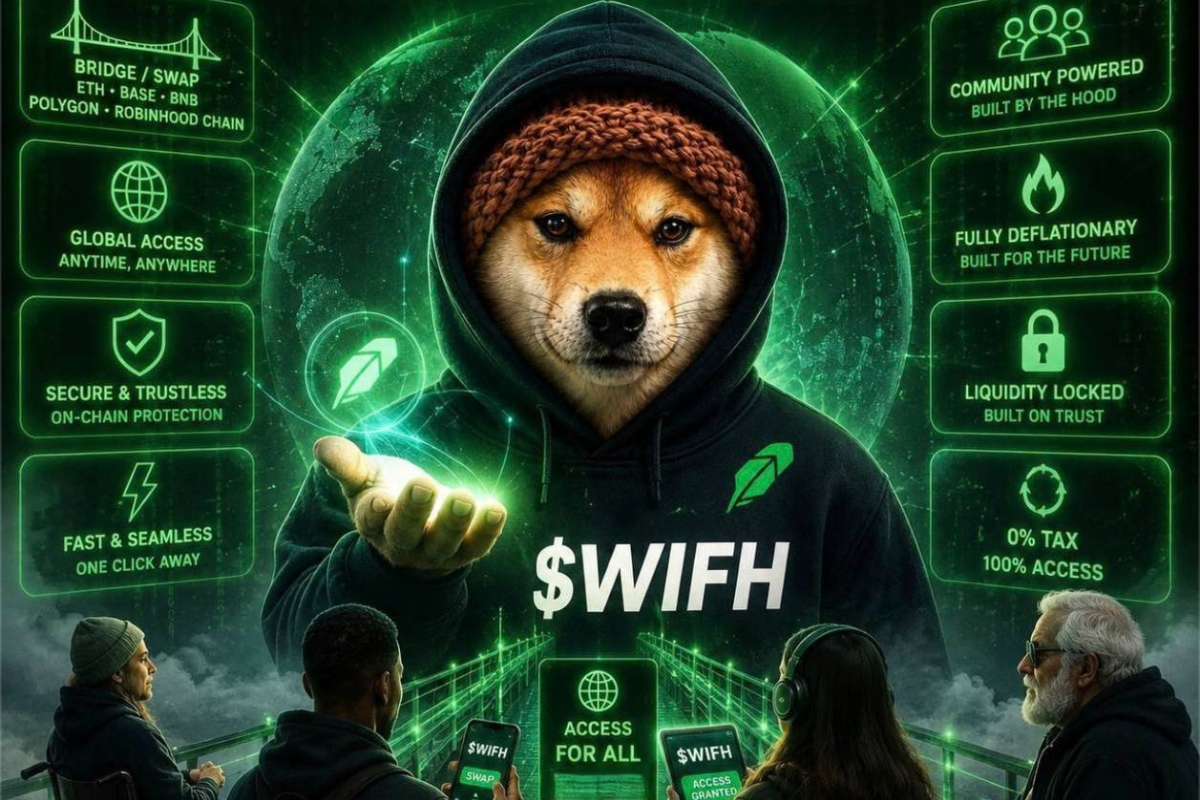

A dog in a hoodie is an unlikely way to introduce someone to a new blockchain, but that is where Dog Wif Hood begins. WIFH launched in July with a token, a mascot and a two-word description from its founder, Cryptofun: ‘Meme + infra.’ The meme is the dog; the infrastructure is everything WIFH has built around it.
- Dog Wif Hood launches the WIFH token with a one-billion supply on Robinhood Chain alongside cross-chain swap tools.
- The ecosystem integrates the Furnace burn tracker and Inspector analytics across Ethereum, Base, BNB Chain, Bitcoin, and Solana networks.
- WIFH operates independently without Robinhood endorsement, attempting to maintain utility after initial speculative retail trading interest declines.
The independent crypto project launched its $WIFH token on Robinhood Chain with a 1 billion supply. It is not affiliated with Robinhood or the separate Solana-based dogwifhat token, WIF. Around the token, WIFH has built a multi-chain swap, a contract-analysis tool called Inspector, a PFP generator and a burn-tracking system called Furnace. The token brings the identity and the entry point; the tools are meant to give users somewhere to go after they arrive.
That makes the harder question less about whether a dog can attract attention. Crypto has already demonstrated that memes can do that. The question is whether the infrastructure built around the dog can become useful on its own.
The Journey Starts With The Token
For someone new to WIFH, the first encounter is straightforward: there is a token called $WIFH, a dog wearing a hood and a new network underneath it. The practical questions begin when that person wants to participate. Their assets may be sitting on Ethereum, Base, BNB Chain, Bitcoin or Solana rather than Robinhood Chain, turning the first transaction into a sequence of decisions about bridging, supported assets and where to swap once the funds arrive.
WIFH’s multi-chain swap is designed around that friction. The project says users can move supported assets from several networks into Robinhood Chain and swap into $WIFH through a single interface, while users already holding assets on Robinhood Chain can swap there directly. Cryptofun describes the intended experience in terms more familiar to online shopping than crypto: ‘One-flow is e-commerce checkout for crypto.’
Have a development worth tracking?
Share product launches, funding announcements, partnerships, research findings and market developments with The Grey Terminal's readership.
→ Submit a Press Release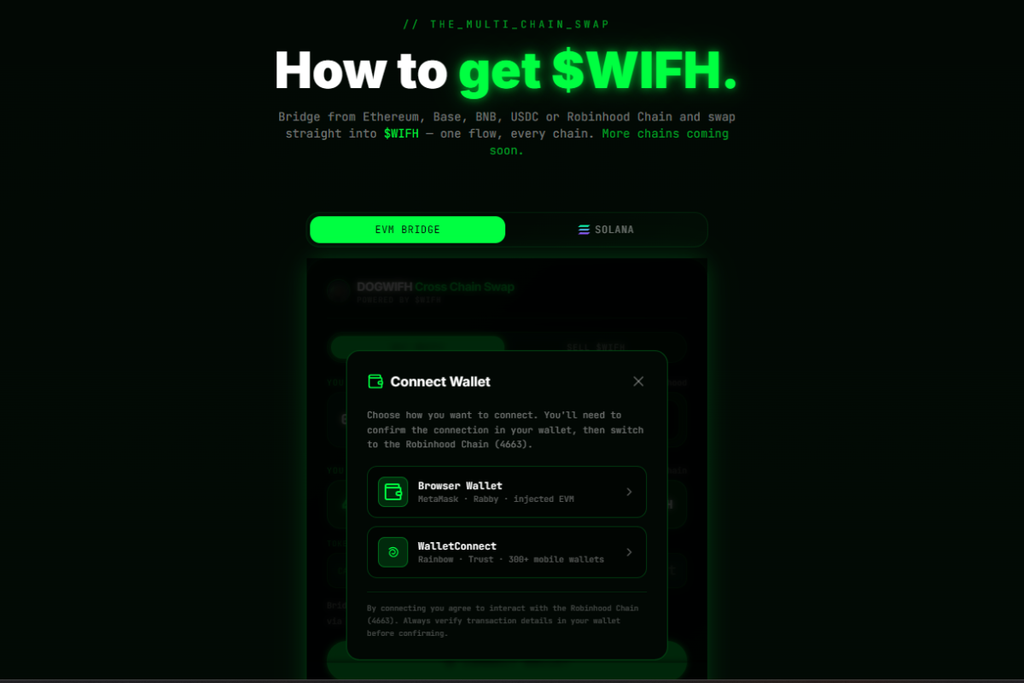
The aim is to keep a user from having to become an expert in bridging before making a first transaction. Instead of assembling several steps across different interfaces, WIFH wants the process to feel like one journey. Once the wallet holds a token, another question appears: what exactly sits behind the address?
Looking Under The Hood
A contract address can tell an experienced crypto user where to start looking. For everyone else, it is a string of letters and numbers hiding questions about ownership, liquidity, taxes, holder concentration and the behavior of the contract itself. WIFH built Inspector for that part of the journey.
Users can enter a Robinhood Chain contract address and receive information about the contract, market data and risk indicators. WIFH says Inspector checks factors including contract verification, ownership status, liquidity, holder concentration, trading taxes and honeypot-related behavior. The tool is intended for other Robinhood Chain contracts, not only WIFH.
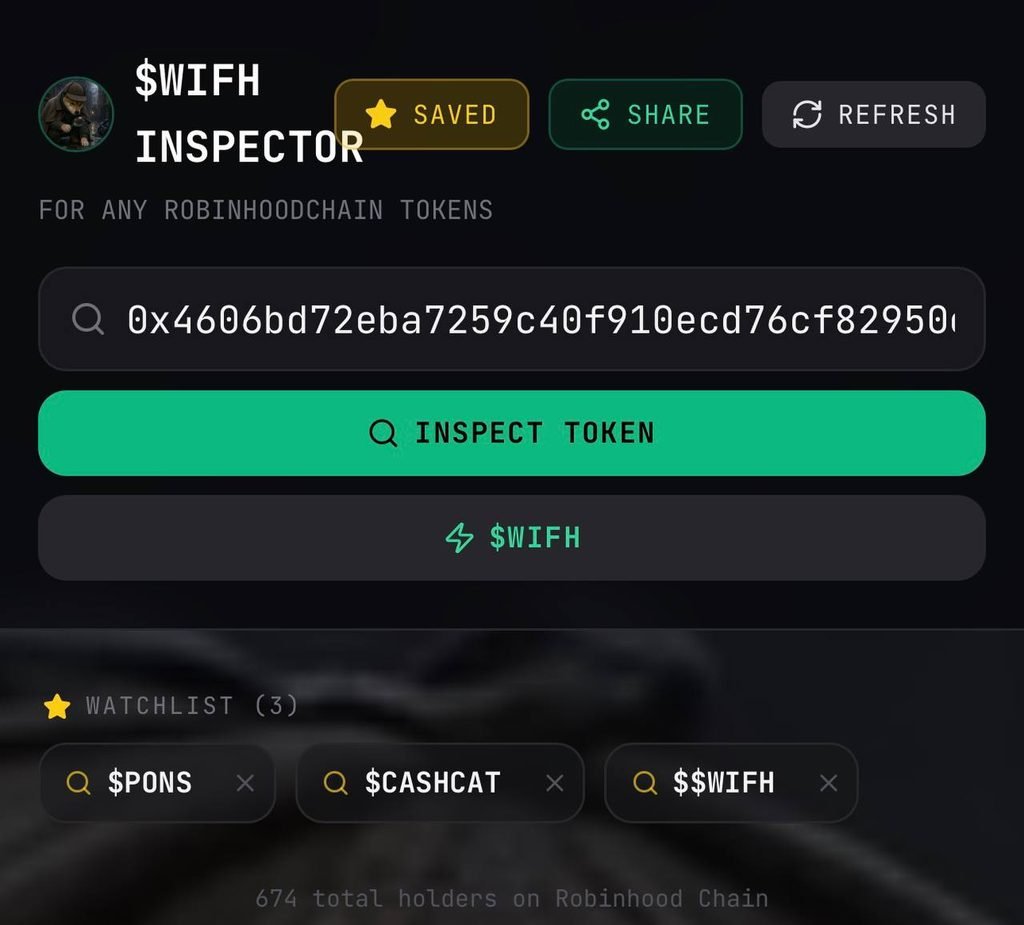
Cryptofun’s experience during the collapse of Terra and UST in May 2022 helped shape the idea. He describes Inspector as the kind of tool he wishes he had before that loss: ‘Tool you wish you had before Luna.’ He said the same standard should apply to WIFH itself. ‘If WIFH can’t pass its own audit, it shouldn’t exist,’ he said.
Inspector does not predict whether a token will rise in value, and a clean result does not guarantee that a project is safe. It gives users information to examine before making their own decision. For Cryptofun, that information should come from the blockchain rather than social-media promises: ‘Transparency is not thread. It’s on-chain proof.’
Then The Dog Becomes Yours
WIFH shifts from contract data back into internet culture with its PFP generator. Users can start with the project’s dog or upload their own photograph, then choose from 12 hoodie colors and more than 16 backgrounds, including settings based on cities such as New York, Tokyo, London, Paris, Dubai, Rio, Miami and Seoul.
Someone arriving with no history on the chain can leave with an identity tied to the project. ‘Instead of telling people make memes, we let them become brand,’ Cryptofun said.
The PFP gives the mascot another role inside the ecosystem. It is no longer only the image attached to a token; users can alter it, carry it and use it as their own. Cryptofun describes the broader logic in another line: ‘Culture brings people. Tools keep them.’ Whether those two forces can work together at scale remains unresolved.
The Token Remains The Center
For all the tools around it, WIFH is still a token project, and $WIFH remains at the center of the ecosystem. Furnace tracks tokens sent to burn addresses and displays the project’s burn activity on-chain. WIFH says its burn system combines transaction-related burns with manual burns.
The project also describes $WIFH as deflationary and says its token launched with no buy or sell tax. Those mechanics can be checked against the contract and transaction history, but they do not establish demand or future value by themselves.
The swap is meant to reduce the friction of getting in. Inspector is meant to make contract information easier to examine. The PFP generator gives the community a shared visual identity, while Furnace records one of the token’s core economic mechanisms. WIFH is building those functions around the same asset, even though each addresses a different part of the user’s experience.
Something Else Is Being Built
The project is not finished adding to that ecosystem. Cryptofun says another element is in development, but WIFH is not ready to name it, leaving that part of the project behind the curtain.
The existing products already give WIFH a defined shape: a meme to draw attention, a route into the token, a way to inspect contracts and tools for giving the community an identity. The harder test comes after the novelty wears off, when those pieces have to remain useful beyond the initial attention surrounding a new token.
Can The Infrastructure Outlive The Meme?
Meme tokens can create recognition quickly, but infrastructure has to remain useful after the novelty fades, when the mascot is no longer new and the market has moved elsewhere. WIFH is trying to make those two forces reinforce each other without making the tools entirely dependent on the token.
The project needs the dog to attract attention, while the infrastructure gives that attention somewhere to go. If $WIFH eventually loses its appeal, the tools will have to demonstrate that they have a purpose beyond the token. Cryptofun accepts that possibility, saying, ‘Even if WIFH fails, swap and Inspector stay useful for Robinhood Chain.’
The token may be what brings people to WIFH. The swap, Inspector and the rest of the ecosystem have to give them reasons to stay. Whether those reasons survive after the meme loses its novelty is the test WIFH has set for itself.
Activate Terminal Layer
Structural analysis of the systems, pressures, and stakeholders behind this story.