

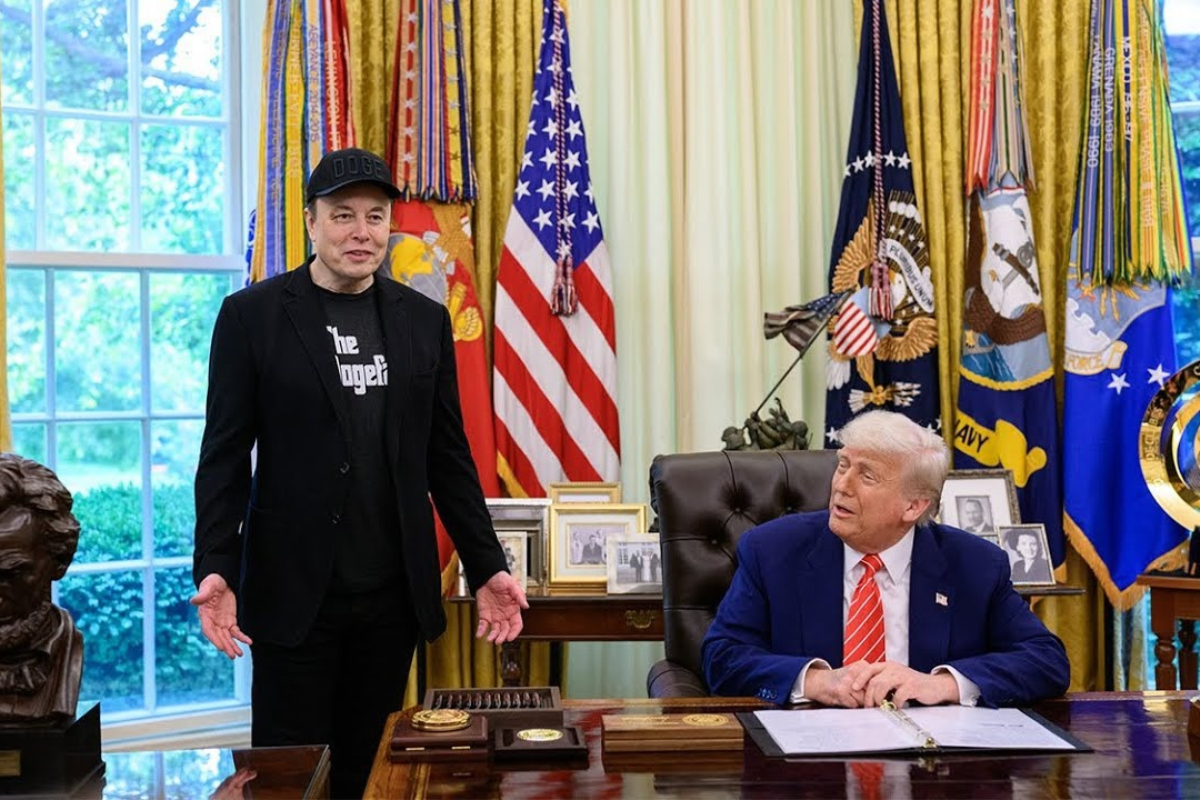

Elon Musk proposed restricting the speed of satellite communications used by Ukrainian forces, and President Donald Trump agreed, according to a report published by The Telegraph on Oct. 16. Citing four people familiar with the discussions, the newspaper reported that the proposal led to limits on Starshield, SpaceX’s military-grade satellite communications service. Ukrainian President Volodymyr Zelenskyy said the restrictions hindered efforts to intercept Russian jet-powered drones threatening civilians.
- The Telegraph reports Elon Musk proposed Starshield satellite speed limits on Ukraine that President Donald Trump approved for Pentagon implementation.
- The 160-kilometer-per-hour connectivity cap prevents Ukrainian interceptor drones from engaging high-speed Russian jet-powered Shahed drones targeting civilians.
- Donald Trump and Elon Musk publicly deny authorizing the satellite restrictions as Volodymyr Zelenskyy demands complete operational restoration from Washington.
One source told The Telegraph that Trump’s agreement cleared the way for the Pentagon to implement the slowdown. Another characterized the two men as jointly involved in the decision, saying: “The reality is that they were both in it.”
Reuters separately reported that the order to limit Starshield came from inside the White House, citing two U.S. officials and a Western official briefed on the matter. Those officials did not identify who issued the instruction.
The Telegraph Report Puts Musk and Trump in the Same Decision Chain
According to the report, Musk approached Trump with a proposal to impose speed limits on the satellite system used by Ukrainian forces. The newspaper cited four sources familiar with the discussions, including one who said Trump agreed to the proposal, allowing the Pentagon to proceed with restrictions on Starshield.
Reuters’ reporting established a separate part of the account: Its sources said the order originated inside the White House but did not identify the official responsible. A senior U.S. official told Reuters that the president had not requested the restriction.
Have a development worth tracking?
Share product launches, funding announcements, partnerships, research findings and market developments with The Grey Terminal's readership.
→ Submit a Press ReleaseThe reported limit affected terminals moving faster than about 160 kilometers per hour, or 100 mph. Ukrainian officials said the restriction complicated the use of interceptor drones against fast-moving Russian attack drones and disrupted other military operations. The precise conversation between Musk and Trump has not been confirmed in a publicly released directive or by either man.
Trump Denies Involvement as Scrutiny Shifts to the White House
Trump denied Friday that he or Musk was responsible for the disruption. Speaking to reporters, he said: “I just checked this morning — it wasn’t us.” He added, “I don’t know if it was anybody, because it wasn’t me and I don’t think it was Elon,” according to Axios.
The denial contrasts with The Telegraph’s account that Musk proposed the restrictions and Trump agreed. Reuters’ sources placed the order inside the White House but did not establish who made the decision.
The available reporting does not establish whether the alleged conversation directly prompted the order. No publicly released directive has identified the decision-maker or documented the full authorization process.
Zelenskyy Says the Restrictions Left Civilians Exposed
Zelenskyy said the reduced connection speeds prevented Ukrainian forces from intercepting some Russian jet-powered Shahed drones used in attacks on civilians.
“We use [Starlink] to intercept jet-powered Shaheds that strike our civilians and kill our families,” he said, according to Ukrainian media reports of his remarks on the sidelines of a European Union leaders’ summit in Brussels.
He stressed that the service had not been switched off entirely. Its connection speed had been reduced. Ukrainian officials said the restrictions also complicated strikes against military targets in Russian-occupied Ukrainian territory and drone deliveries of water and food to troops.
The reported speed limit posed a particular problem for interceptor drones pursuing faster targets. However, available reporting did not independently establish how many interceptions failed because of the slowdown or link specific civilian deaths directly to the restrictions.
Former Ukrainian Defense Minister Mykhailo Fedorov said connectivity at speeds of up to about 160 km/h was being restored and called for the restrictions to be lifted entirely. Kyiv was negotiating with SpaceX and the Pentagon, but full restoration of unrestricted connectivity had not been confirmed in the reports available Friday.
Musk Had Already Pointed to Trump’s Authority
On Oct. 14, two days before The Telegraph published its report, Musk said on X that the U.S. government controlled restrictions on Starshield.
“Starshield systems are owned and controlled by the US government. Any limits on speed or usage are decided by the US military and ultimately POTUS,” he wrote. POTUS is a common acronym for the president of the United States.
Musk distinguished Starshield from Starlink, SpaceX’s commercial satellite internet service. He described Starlink as owned and controlled by SpaceX and limited to civilian or defensive uses, while Starshield was controlled by the U.S. government.
His statement pointed to the U.S. government’s authority over Starshield but did not identify who ordered the specific slowdown affecting Ukraine.
Ukraine Seeks the Removal of the Speed Limit
Ukrainian officials said the restrictions emerged overnight around Oct. 13-14, disrupting military operations. The reported 160 km/h threshold affected terminals on fast-moving platforms, creating problems for interceptor drones pursuing Russian attack drones.
Kyiv has been negotiating with SpaceX and the Pentagon to remove the restrictions. Ukrainian officials reported partial restoration of connectivity, but unrestricted service had not been confirmed in the reporting available Friday. The Telegraph’s account links Musk’s proposal to Trump’s reported agreement; Reuters independently traced the order to the White House without identifying who issued it. Trump denied responsibility.
Activate Terminal Layer
Structural analysis of the systems, pressures, and stakeholders behind this story.